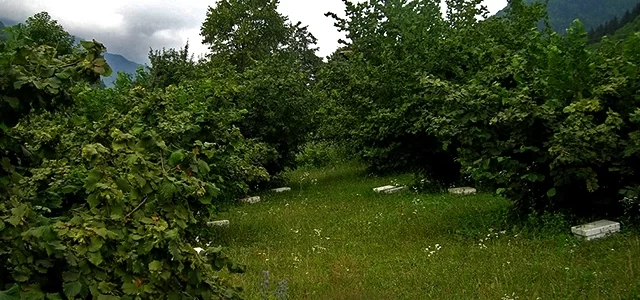
This guide summarises the Turkish article on hazelnut farming published in our Knowledge Center, covering the points that matter most to buyers: where hazelnuts grow, and how harvesting, drying and storage protect their quality.
Origin of the Hazelnut
The hazelnut has been known for about 5,000 years and its homeland is Anatolia. Around 400 BC it was called the “Pontic nut”, after the Black Sea (Pontus) coast it came from, and it was later taken to Sicily and Spain. Hazelnuts grow in a narrow band of climates in the northern hemisphere and bear fruit within about 30 km of the sea and below roughly 750-1,000 metres. The majority of the world’s hazelnuts are grown on Türkiye’s Black Sea coast; Italy, Spain and the United States are other producers.
A Crop That Protects the Land
The Black Sea region is Türkiye’s wettest, and its slopes are usually steeper than 20%. Soil and climate leave little room for other crops in much of the region. Hazelnut orchards hold the fertile soil on these slopes and prevent erosion, and hazelnut processing produces no physical or chemical waste that damages the environment.
Harvesting
- Hazelnuts should be picked by hand once ripe, without damaging the shoots and buds that will carry next year’s crop.
- Where the ground allows, cloths or tarpaulins are spread under the trees and the nuts are shaken down onto them.
- Nuts that fall to the ground must be collected straight away and never left until the next day. Long contact with soil raises their moisture and leads to mould and aflatoxin.
- Hazelnuts should not be harvested in the rain or kept wet in sacks.
- Late harvesting increases contact with the soil and cracking of the shell, which increases mould contamination and lowers quality.
Drying
- After husking, the nuts are spread 2-4 cm deep on cloth or jute on a clean, hard, level or gently sloping drying floor, never directly on soil or on plastic sheeting.
- Freshly husked nuts still hold a lot of moisture and should be dried to about 5% moisture within two days at most.
- In simple dryers they can be dried in 20-25 hours, but the temperature must not exceed 40 °C: sudden water loss at higher temperatures harms flavour and quality.
- When covered against rain, a gap of at least 25-30 cm is left between the nuts and the cover.
Storage
- The store must be cool, dry and well ventilated. Under these conditions hazelnuts keep their qualities for up to one year.
- For longer storage the temperature should be 2-4.5 °C and the relative humidity 55-60%. Higher temperatures cause rancidity; higher humidity causes mould.
- The store should be out of direct sunlight, raised above flood level and insulated against temperature changes, with a roof that does not leak and no water or sewage pipes inside.
Preventing Aflatoxin
Aflatoxin is a mycotoxin produced by the moulds Aspergillus flavus and Aspergillus parasiticus. Mould growth can begin in the orchard and increase with poor harvesting and drying and during storage and transport. The risk is highest in the first days of sun drying, while the nuts still have high water activity; natural kernels are more at risk than roasted kernels.
Importing countries set strict maximum levels for aflatoxins in hazelnuts. Clearing weeds before harvest, harvesting each variety when ripe, collecting fallen nuts at once, drying quickly and storing correctly are the key steps to keeping hazelnuts within these limits. Buyers should state the limits that apply in their market when they request a quote.
What Is in a Hazelnut
The Turkish article lists the following values per 100 g of hazelnut kernels:
| Nutrient | mg / 100 g |
|---|---|
| Vitamin E | 31.4 |
| Vitamin B1 | 0.33 |
| Vitamin B2 | 0.12 |
| Vitamin B6 | 0.24 |
| Niacin | 1.75 |
| Potassium | 655.3 |
| Magnesium | 161.2 |
| Calcium | 160.0 |
| Iron | 5.8 |
| Manganese | 5.1 |
| Zinc | 2.2 |
| Sodium | 2.1 |
| Copper | 1.3 |
About 80% of hazelnut kernels are used by the chocolate industry, whole or diced, sliced or ground, and in biscuits, confectionery, desserts, cakes and ice cream. They are also eaten as snack nuts.
Written by Tahsin Fındık · Last updated: